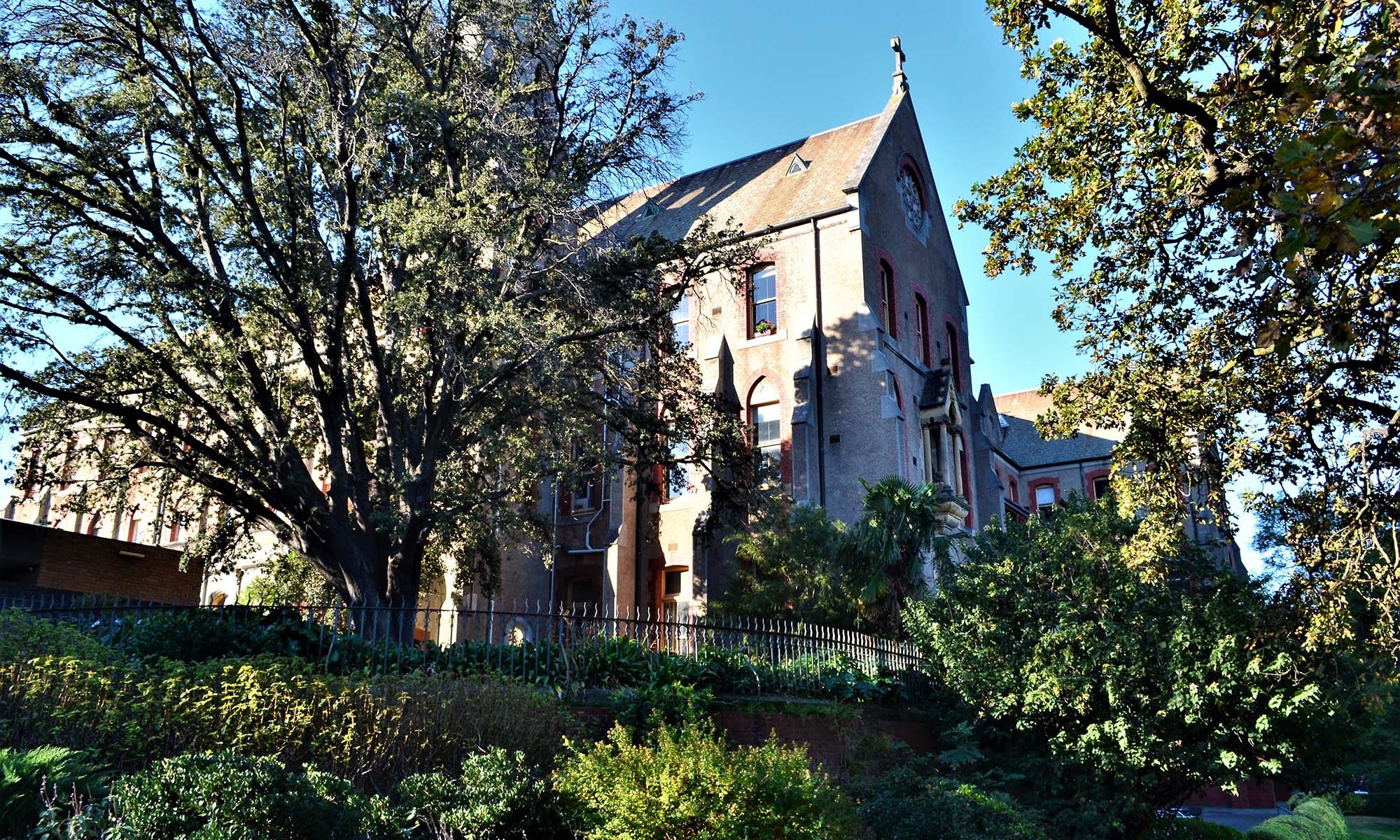
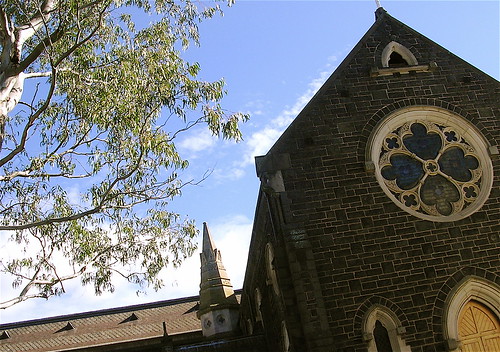
I received from Miss K for Christmas Catherine Kovesi’s book Pitch Your Tents on Distant Shores (2006, Playwright Publishing), a beautifully written and very substantial large-format hard-back history of the founders of the Abbotsford Convent, the Sisters of the Good Shepherd. It was, and may still be, available from the Sisters’ Provincialate Office at the discounted price of $55. It is remarkable in being quite accessible to the lay reader whilst doing what institutional histories must do. It has many photos of the Abbotsford Convent. Not given to reading religious histories, I am enjoying it.
No doubt it is a commissioned history, which may explain this frank admission in the introduction:
“More problematic has been the question of the stories of those numerous girls and women who found themselves occupants of the many institutions of the Sisters of the Good Shepherd. Victims of a society which saw women who deviated in any way from the norm as outcasts, they have stories, often of excruciating pain and heartbreak. Whilst I have tried to include some of these stories, the prime focus of this study has been the sisters themselves and their work. I hope that this might provide a foundational backdrop for others to publish work on the lives of the former residents and inmates whose stories need telling.”
But it is clear that Dr Kovesi rails against too hysterical an imagination of the strictures imposed by severe nuns on their wards (referred to as “children” regardless of their age) by blind assumptions based for example on Marxist Peter Mullan‘s film The Magdalene Sisters. It horrified Melburnians a few years ago with its depiction of depraved sadism of Catholic nuns towards “fallen women” in 1960s Ireland. Dr Kovesi says “In the case of the Sisters of the Good Shepherd there has been not so much a shortcoming of history, as a shortage of it altogether and speculation has been allowed to run unchecked,” and suggests such speculation is but the most recent in a centuries old history of disparagement in certain quarters amounting to a “‘Magdalen’ genre”. (The common view of Mary Magdalen, to whom Jesus is said to have first revealed his resurrection, since the 13th century is of a prostitute, however she is referred to in the Bible only as a sinner who tearfully repented her sins to Jesus). Dr Kovesi says:
“For many Catholics the work of the Sisters of the Good Shepherd behind these enormous walls was the subject of hushed conversations, usually out of earshot of younger children in the household, with the occasional threat to their teenage daughters that if they behaved badly they would end up in the care of the sisters. …
For non-Catholics, what went on behind the walls of this and other complexes of the Sisters of the Good Shepherd was often the subject of rampant speculation and, at times, outrageous assertion. The sisters were described as ‘torturing demons, proselytising the souls and battening upon the bodies of their luckless victims’, the convent represented as a ‘gloomy prison wherein girls and women, as well as young children, are immured and most cruelly tortured, and a place where’s God’s sunshine of a smile is ever absent.’ The Sisters were accused of running sweatshops, of undercutting competitors in the marketplace, of forcing women to stay against their will. Common to these views was that of the walls as sinister and negative; the privacy they afford was seen as allowing heinous acts to be performed, their height was seen to be aiding the imprisonment of the inhabitants.”
Dr Kovesi records that the Sisters did not entirely escape the wave of complaints about institutional abuse in the 1990s, but did comparatively very well given the vast numbers of residents who had passed through their door. She emphasises that unlike some other religious orders, corporal punishment was absolutely banned, no complaints of sexual abuse were levelled against the Sisters in Australia, and she found no evidence of residents being detained against their will. Indeed, there was a “no touching” rule which it is suggested led, ironically, to an unfortunate absence of physical affection.
There is no record in the book of any complaints made by former residents of the Abbbotsford Convent to the Senate Enquiry into Children in Institutional Care. It seemed to me from the Report itself that there were in fact 4 such complaints. I asked Dr Kovesi about the apparent discrepancy, and she explained to me that though there were 4 submissions referring to Abbotsford Convent recorded in the Senate report, none was made by a former resident of the Abbotsford Convent, and a mention in a submission is not necessarily a complaint.
The book notes that between 2000 and 2005, the Sisters settled 39 claims from former residents of the Sisters’ many residential institutions in Australia, pointing out that the majority of these claims addressed the lack of educational opportunities provided by the sisters. Given the numbers who passed through their institutions, in other words, they fared well. The fact that the claims were settled out of court tells us nothing about the settlements, especially as the claims were made in a system designed to reach a negotiated settlement.
It is a pity that this book makes eleven factual errors in a couple of paragraphs regarding events in Perth in the late sixties, all to the detriment of the good name of Sr Mary O’Brien and Sister Patrice Cooke. In spite of repeated attempts to have this rectified nothing has been done. It makes one wonder about the acuracy of the rest of the book and the integrity of those responsible for its being published
i fully agree with you i personally have not read this book but i have heard of alot of things written in the book are wrong i was in the good shepherd convent as a child and certain things they write about are wrong the documentation should have been done better regarding the book
I to was there marilyn Fitzpatrick
, and she found no evidence of residents being detained against their will. Indeed, there was a “no touching” rule which it is suggested led, ironically, to an unfortunate absence of physical affection.
I was in abbotsford and it was little more than a prison. There was no way to walk out the door, they were all locked. I was forcibly restrained more than once trying to get away. As far as I'm concerned the only good sister of the good shepherd is a dead one. May they all rot in hell.
Well they weren't horrible JUST STRICT…..most of the girls there were BRATS including myself…..and i have been reading these bloggs for ages now and APPAULLED at the comments…..WHAT DID THE NUNS DO ???? that was so horrific …….i was there and saw NOTHING of the likes…..they were looking after rebelious kids with tatts and dyed hair that swore at them often…..those poor nuns had to run that place and they certainly weren't young themselves……then they had to look after all the very old women that NOBODY ELSE WANTED…..The nuns RARELY yelled as they had the clap thing for correspondence…….THE NUNS WERE VERY PATIENT SOULS and looked after us FINE.
Melody those nuns were liars, I was told my family just dumped my things on the doorstep. In truth my sisters were told by the nuns I didn't want to see them. I received no mail that was sent to me. No letters I wrote were mailed. I was not told of my cousins illness or death.
I was not a bad girl I was abused and for that I was punished by being made a state ward, thrown into the system and forgotten, while my abuser was free to do it again. The nuns didn't need to beat us that's why they had the auxiliaries.
We weren't held against our will.. hahaha. Who are they trying to kid ?
well i never heard of or seen a bad thing done while i was there……..except by the girls that were there….
yes we were held against our will …….BECAUSE we were made Wards of the State ……but the Nuns didn't do that. We were just plonked on the door steps of the convent by the State. I can only feel for the Nuns.
I used to go to the Good Shepherd Convent to umpire Basketball (now Netball) once a fortnight in late 1950's and early 1960's. My father's first cousin was Sister Irene (Castles) a very short lady . Sister Irene handled the girls very well and they had respect for me, or Sister Irene would order them off the court. I haven't read the book, but I am sure it would be interesting. Could you tell me how I could get details of my late cousin and her sister Sister Frances(Castles) who was at the Good shepherd Convent in Queensland? I am doing Family History and would appreciate some details as my parents are dead.
Hi there. My name is Richard Bullock. My wife and I are currently in the beginning phases of a documentary on the Convent. My start point is an interview with an ex- St Mary's Class girl who arrived in 1932. If you are interested in telling your story we'd love to hear form you. Please email me bullusto@gmail.com
At this point in time I don't want to be part of this, but wish you all the best.